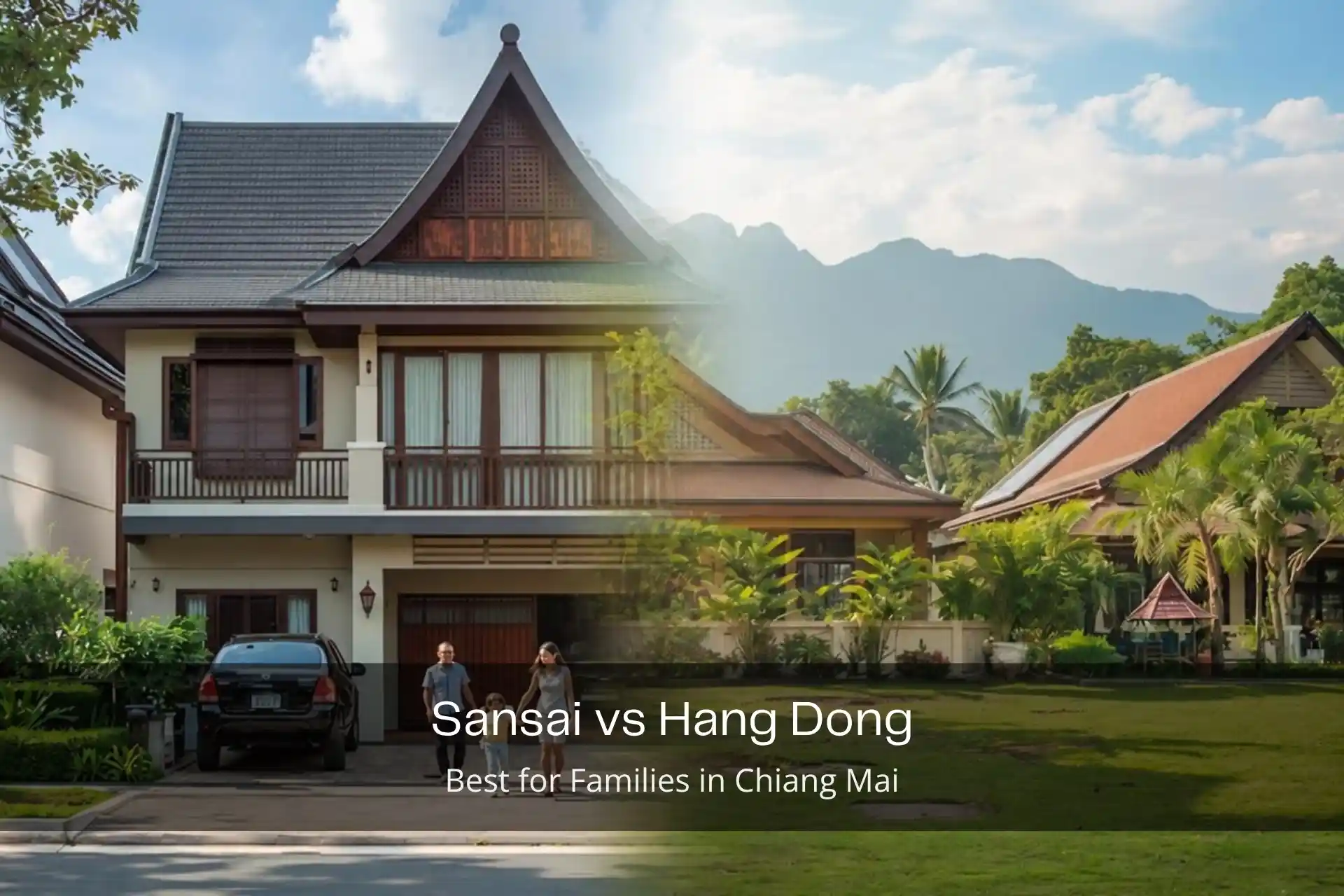

In our experience, this is the question we hear most from families arriving in Chiang Mai on DTV or retirement visas with school-age children. Both districts offer yard space, gated communities, and access to international schools — but they pull in very different directions. We have observed that families who prioritise school proximity and western amenities gravitate toward Hang Dong,while those who value budget, city access, and a quieter residential feel increasingly choose Sansai
Picture the Saturday morning school run at 7:45 AM.One family is turning off Highway 108 into Nam Phrae, heading toward Panyaden's bamboo gates as the mist still clings to the hills. Another is ten minutes north of the moat, pulling into a Sansai moo baan as their kids spot their Thai neighbours riding bikes in the cul-de-sac. Both are expat families. Both chose Chiang Mai for the same reasons — space, schools, and sanity. But their day-to-day lives play out very differently.
This is the ground-level comparison we give everyfamily who asks us where to look first. No generic rankings just what we've seen work, and for whom.
Is Hang Dong or Sansai better for international schools in Chiang Mai in 2026?
Hang Dong holds the clear advantage for in-district international schooling. It is home to three international schools: Panyaden in Nam Phrae, Lanna International in Ban Waen, which has been operating for over 33 years, and Grace International, now on a purpose-built 37-acre campus in Han Kaeo. Sansai has strong bilingual options and is well-served by school bus routes, but families focused exclusively on Tier 1 international education will find more within a shorter drive in Hang Dong.
Chiang Mai has 19 international schools as of 2026, with the majority clustered south of the historic centre which naturally favours Hang Dong. The average annual fee for a 12-year-old across all Chiang Mai international schools sits at approximately 384,000 THB, with Tier 1 schools ranging from 200,000 to over 1,000,000 THB per year depending on grade level.
What we observe on the ground: Families whose children attend Panyaden almost universally live in Hang Dong or the Nam Phrae / Nong Kwai sub-districts it simply makes the daily logistics manageable. One correction worth making, because we have repeated it ourselves: Prem Tinsulanonda is often described as a Hang Dong school, but it sits in Huay Sai, Mae Rim, roughly 25km north of the city. Families with a place at Prem are better served north of the moat, which marginally favours Sansai over Hang Dong. We have seen Sansai-based familiesmake it work with school bus arrangements, but it adds 60–90 minutes to the family's combined daily commute time during peak term.
How doproperty prices and family home options compare between Sansai and Hang Dong in2026?
Sansai offers the most affordable entry point for family housing in Chiang Mai newtown houses from 2.5M–4.5M THB and detached houses from 3.5M–8M THB. Hang Dong's family villas and pool homes run 6.8M–20M THB, with the premium reflecting larger plots, western-standard finishing, and proximity to the international school corridor. For the same budget, Sansai delivers more square metres.
We have observed that Sansai's newer housing developments particularly along the San Sai–San kamphaeng Road corridor attract families who want a move-in-ready modern home without the Hang Dong price tag. Many DTV holders in particular arechoosing Sansai for a first year of renting before committing to a purchase decision. Hang Dong, by contrast, tends to attract families who arrive with a confirmed school place and want to lock in housing within the school's natural catchment.
What is the commute like from Sansai and Hang Dong to Chiang Mai city centre?
Sansai has a genuine commute advantage for familieswhere one parent works near the old city, Nimman, or the university. From central Sansai to the moat, the drive runs 15–25 minutes outside peak hours.Hang Dong to the city centre runs 25–40 minutes, with Highway 108 congestion aknown pain point during school-run hours though the 2026 Smart Traffic signalupgrades have improved predictability significantly.
The counter-intuitive insight: Most families assume Hang Dong's proximity to theairport is a minor convenience. In our experience, for families with relativesvisiting regularly or a parent who travels frequently for work, the 15-minuteairport run from Hang Dong versus 30+ minutes from Sansai becomes a genuine quality-of-life factor especially during the mango season school holiday rush.
Why does the Sansai vs Hang Dong decision matter more in 2026 than it did three years ago?
Two structural shifts are reshaping both districts. Hang Dong's land prices have risen 15–20% over the past three years as the airport's southern expansion made the Highway 108 corridor more accessible. Meanwhile, Sansai is seeing a wave of new housing developments along the Third Ring Road, attracting families who previously defaulted to Hang Dong purely out of familiarity. In 2026, Sansai is genuinely competitive not just a budget fallback.
Hang Dong's trajectory. The completion of the Smart Traffic signal system on Highway 108 has made the commute more predictable. Combined with the consistent influx of expat families, high-quality 3- and 4-bedroom villas in Hang Dong maintain strong occupancy and rental yields of 6–8% annually. For investors, it remains the "safe bet" in the family housing segment but entry prices reflect that confidence.
Sansai's emerging case. What we are seeing on the ground in Sansai in 2026 is a district in transition. New housing estates along the Third Ring Road and toward the San kamphaeng corridor are attracting younger expat families who want modern builds, larger plots, and genuinely lower monthly costs — while staying within 20–30 minutes of both the city and the airport via the Ring Road bypass.The new Mill Hill International School in nearby Doi Saket (opened 2025, British curriculum) is also shifting the school map northward for the first time in a decade.
The DTV factor. Wehave observed that Digital Nomad Visa holders with families tend to trial Sansai first lower rent means lower financial risk during a first year. After 12 months, families who are city-oriented stay in Sansai or move inward; families whose children are settled in a Hang Dong school make the permanent move south.
People Also Ask
Which area is safer for families — Sansai or Hang Dong?
In our experience, both districts are genuinely safe by any international standard, and safety is rarely a deciding factor for families choosing between them. What varies is the feel: Hang Dong's established expat enclaves in gated communities offer a more enclosed, familiar environment, while Sansai's newer estates have a more mixed Thai-expat community dynamic. Many residents find Sansai's local neighbourhood feel an asset for children's language development and cultural integration.
Can foreigners buy a family house in Sansai or Hang Dong?
Foreigners cannot own land freehold in Thailand, so detached houses in both Sansai and Hang Dong are typically accessed via 30-year (extendable) leasehold or through a Thai spouse or company structure. Condominiums within the 49% foreign quota remain the only straightforward freehold option. In our experience, most expat families in both districts opt for long-term leasehold on a house rather than a condo the space-to-cost ratio is simply more suited to family life. Always consult a qualified Thai legal professional before structuring any purchase.
What is the monthly cost of living for a family in Hang Dong vs Sansai?
A comfortable family budget in Hang Dong typically runs 80,000–130,000 THB per month including rent, school fees (prorated), utilities, food, and transport the premium is driven mainly by housing costs and school proximity. In Sansai, the same lifestyle profile runs 55,000–90,000 THB per month, with the gap almost entirely explained by lower rent. International school fees — averaging 384,000 THB per year per child — are the same regardless of which district you live in.
The Bottom Line: Which Area Is Right for Your Family?
There is no universal answer — but there is usually a clear answer for each family once you map their specific situation against the district's strengths.
Choose Hang Dong if: your children are enrolled or applying to Panyaden, Lanna International or Grace International, you travel frequently via the airport, and your budget comfortably covers 35,000–80,000 THB/month in rent or a purchase above 8M THB. The infrastructure is the most mature, the expat community the most established, and the school logistics the simplest.
Choose Sansai if: you are in a first year on DTV and want to keep costs lower while you assess the city, your children are in a bilingual or central city school, or one parent works near Nimman or the Old City. The newer housing stock, shorter city commute, and meaningfully lower price points make Sansai an increasingly credible first choice — not just a compromise.
Ready to explore family homes in Sansai or Hang Dong? Browse our latest listings at Chiangmai Properties or contact our team to find your perfect fit in the North — we'll match you to the right district based on your school, budget, and lifestyle priorities.

%2520(1).webp)